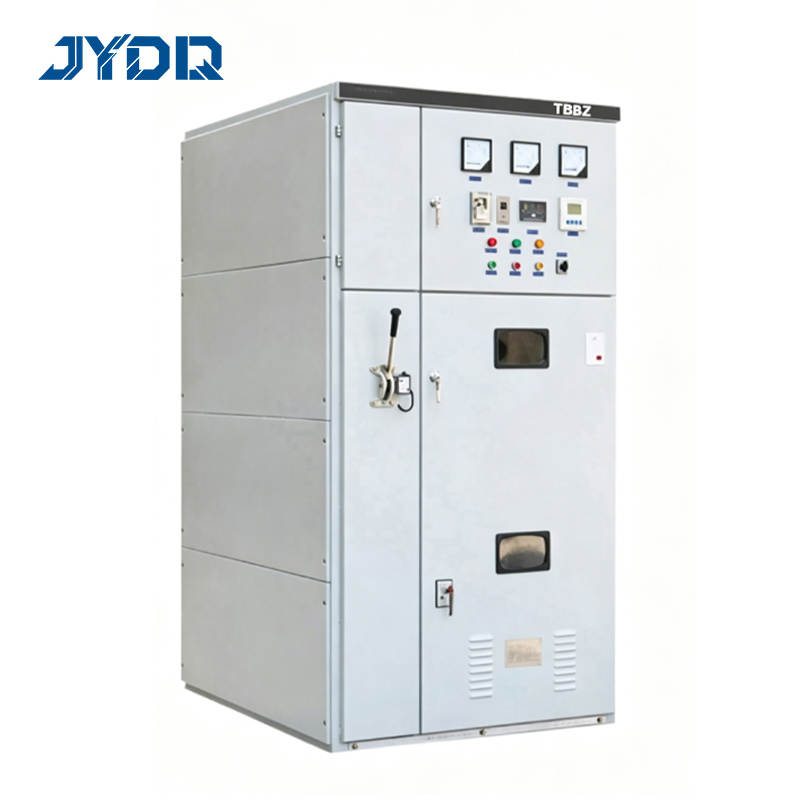
What Is TBBZ High-Voltage Compensation Switchgear?
TBBZ High-Voltage Compensation Switchgear is a reactive power management cabinet designed for automatic compensation on 6kV, 10kV, 35kV, and 110kV substation busbars. Its primary function is to track and compensate reactive power demand in real time, improving power factor and stabilizing busbar voltage across the connected distribution network.
Unlike fixed capacitor banks, TBBZ switchgear integrates an automatic reactive power controller that continuously monitors reactive demand and switches capacitor stages to maintain a target power factor. The short answer is: these units reduce reactive energy charges and feeder losses. The longer answer is: how effectively they perform depends on the control logic, harmonic suppression design, and compatibility with the substation protection scheme. The edge case is that if any of these variables falls outside standard assumptions—particularly in markets with significant grid voltage instability—compensation accuracy and equipment service life can diverge from the nameplate rating.
Key Technical Characteristics
When evaluating TBBZ High-Voltage Compensation Switchgear for cross-border procurement, the decision involves more than rated voltage and capacity. The parameters that determine real-world compensation performance include:
Automatic reactive power tracking: The compensation controller continuously monitors power factor and switches capacitor stages to maintain the target set point, eliminating manual adjustment and supporting continuous optimization.
Rated voltage and capacity range: Standard units cover 6kV and 10kV systems; extended configurations support 35kV and 110kV bus applications. Typical industry capacity ranges from 100 to 10,000 kvar, with multi-stage switching enabling incremental compensation steps matched to the load profile.
Harmonic protection: Facilities with variable speed drives, rectifiers, or UPS systems generate harmonic currents that interact with capacitor banks. TBBZ designs incorporating detuned reactor units—with reactance ratios typically at 4.5%, 6%, or 12%—limit harmonic amplification and protect capacitor service life. Three harmonic-matched reactance ratios address different industrial load profiles.
Discharge protection: Capacitor banks carry residual voltage after disconnection. TBBZ units include discharge mechanisms that reduce residual voltage to a safe level—typically within 5 seconds—before allowing reconnection. This is a safety and equipment protection requirement.
Motorized circuit breaker operation: Reliable motorized circuit breaker operation is required for high-voltage compensation switching cycles, supporting rapid and repeatable operation with remote-control capability without accelerating contact wear.
Environmental protection: Enclosure rating, insulation class, and corrosion protection must be matched to the installation environment. Sites in tropical, coastal, or high-humidity regions require specifications beyond standard assumptions.
Common Application Scenarios
TBBZ High-Voltage Compensation Switchgear is applied where reactive power management is a system-level requirement rather than an optional efficiency measure:
Industrial manufacturing substations: Plants with large induction motor loads—steel mills, cement factories, petrochemical complexes—use TBBZ compensation switchgear at the 10kV substation busbar to reduce reactive demand from the grid, lowering demand charges and feeder losses.
Utility distribution substations: 10kV and 35kV substation operators install TBBZ compensation switchgear to maintain busbar power factor within network standards, improving voltage regulation for downstream customers.
Infrastructure projects in developing markets: In many grid environments across Asia, Africa, and South America, actual voltage variation over a daily operating cycle routinely exceeds the assumptions behind compensation equipment designed for stable grids. For these projects, TBBZ switchgear with extended control ranges and robust transient withstand capability is specified rather than standard catalog units.
Renewable energy grid connection: Solar and wind projects specify reactive power compensation at the grid connection point to manage reactive exchange during variable generation conditions.
How to Choose the Right TBBZ Configuration
Selecting TBBZ High-Voltage Compensation Switchgear requires addressing four evaluation dimensions. The distinction between a standard 10kV TBBZ configuration and a project-specific design is not cosmetic—at the rated reactive capacity and control step granularity, it translates directly into compensation accuracy under varying load conditions.
Define the reactive load profile
Capacity selection should reflect the actual reactive demand profile, not a conservative estimate. If your facility operates consistent production loads, a fixed-stage TBBZ configuration may satisfy the requirement. Once you introduce variable process loads or significant non-linear load contributions, you will want to review the number of switching steps and the harmonic detuning ratio before finalizing the specification.
Assess harmonic conditions
Industrial facilities with large variable speed drives, rectifiers, or UPS systems present harmonic currents that interact with capacitor banks. Characterizing harmonic levels before specifying compensation equipment prevents resonance conditions and accelerated capacitor aging. The reactance ratio selection—4.5%, 6%, or 12%—determines whether the TBBZ compensation system attenuates or amplifies harmonics at the compensation point.
Confirm control system integration requirements
TBBZ compensation controllers must integrate with the substation measurement and protection infrastructure. Buyers should confirm communication interface requirements before procurement—particularly if the substation is part of an ami advanced metering infrastructure network or a digital protection architecture. Integration with an ami advanced metering infrastructure environment may require additional interface modules that affect the controller specification and cost.
Evaluate customization scope
Standard catalog TBBZ units offer shorter lead times, but when voltage requirements, enclosure ratings, or control interface specifications deviate from standard assumptions, the cost of an underperforming unit often exceeds the cost of a customized design specified at order stage. Buyers configuring substations that include an amorphous alloy core transformer on the compensation bus, or a transformer with cable box interface at the busbar connection, should confirm interface coordination between the TBBZ switchgear cubicle and the transformer with cable box assembly before finalizing the substation layout.
Why Reactive Power Compensation Matters for Industrial and Utility Buyers
TBBZ High-Voltage Compensation Switchgear addresses engineering, procurement, and operational requirements simultaneously. For engineers, the relevant parameters are compensation accuracy, harmonic protection design, and protection system compatibility. For procurement teams, the focus is compliance documentation, delivery reliability, and supplier pre-qualification capability. For finance and operations reviewers, the case centers on reactive power penalty avoidance and distribution network loss reduction over the equipment service life.
When a product or application is subject to technical standards, the relevant electrical equipment standards—covering capacitor bank design, switchgear construction, and reactive power control—should be confirmed with the supplier and the applicable certification body for the target market before finalizing the specification. Standard compliance documentation is frequently required for grid authority pre-energization approval in regulated utility markets. Customization capability covering control parameters, protection settings, and environmental specifications should be confirmed with the supplier before bid submission. For EPC contractors and utility procurement teams, early supplier engagement—resolving customization scope and documentation requirements before order placement—reduces commissioning risk on critical-path equipment.


 EN