Website: jydqhv.com (Zhejiang Jingyu Technology Co., Ltd. — JYDQ) | Prepared: 26 September 2026 | Language: English (US)
Part 1 — TDK (Search Metadata)
Field |
Value |
SEO Title (title tag) |
Outdoor SF6 Circuit Breaker Guide for 110–145 kV Substations (61 characters) |
Meta Description |
Eight questions buyers ask before specifying an outdoor SF6 circuit breaker: breaking current, IEC 62271-100 type tests, creepage, gas tightness, delivery. (155 characters) |
H1 (page heading) |
Specifying an Outdoor SF6 Circuit Breaker for 110–145 kV Substations: Eight Questions Buyers Ask Before Signing |
Focus Keyword |
SF6 circuit breaker |
Secondary Keywords |
outdoor high voltage SF6 circuit breaker; sulfur hexafluoride circuit breaker; 110kV SF6 circuit breaker; 145kV outdoor circuit breaker; LW series SF6 circuit breaker; SF6 circuit breaker manufacturer |
Long-tail / Semantic Terms |
IEC 62271-100 type test; KEMA type tested; near-zone (short-line) fault; creepage distance pollution class IV; SF6 gas tightness; 0.60 MPa SF6 density; M2 class mechanical endurance; auto-reclose circuit breaker; MOQ and lead time for SF6 circuit breaker |
URL Slug (suggested) |
/outdoor-sf6-circuit-breaker-guide-110-145kv-substations |
Article Format |
Q&A technical guide (8 buyer questions) with one hero image |
Word Count |
1100 words (article body incl. author box, excluding title and image caption) |
Focus-Keyword Density |
“SF6 circuit breaker” appears 6 times in 1100 words (≈0.55%) — natural usage, no keyword stuffing |
Image File Name |
outdoor-sf6-circuit-breaker-110-145kv-substation.jpg |
Image ALT Text |
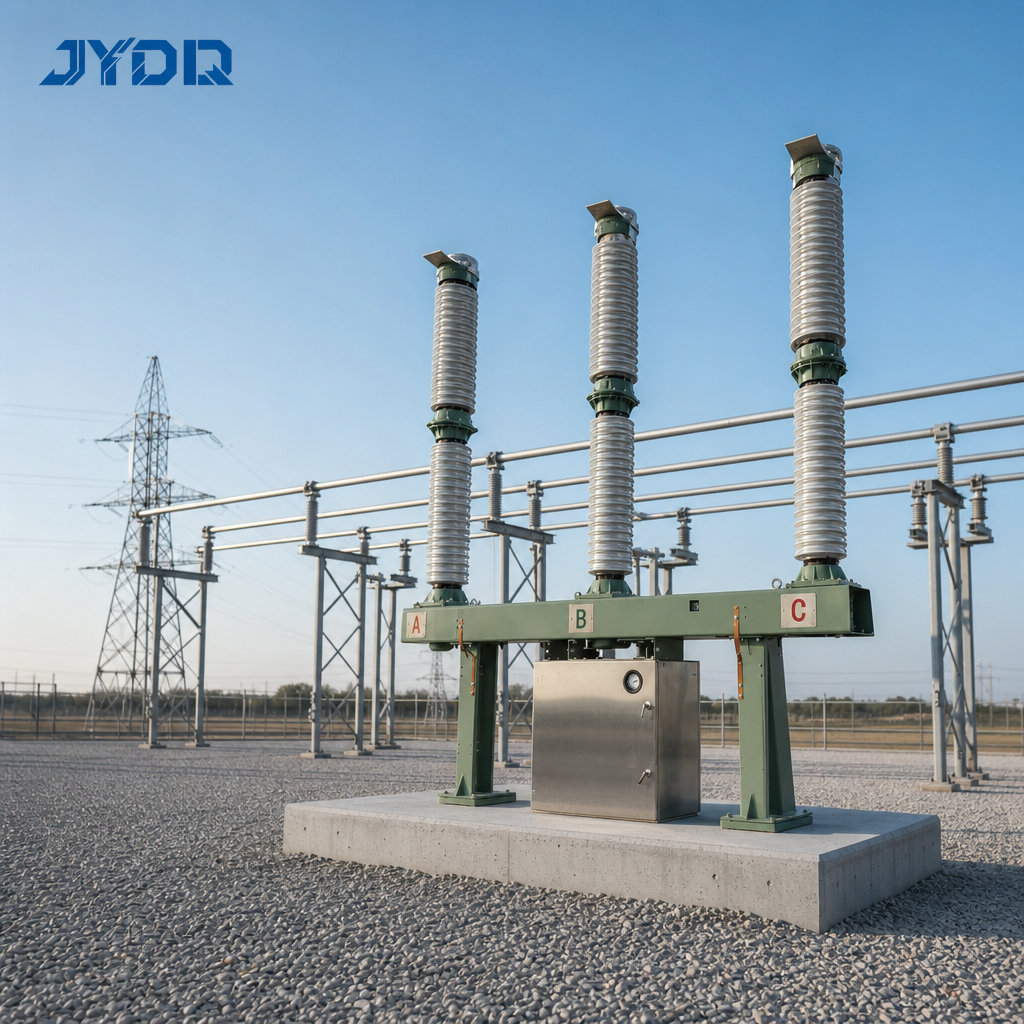
Three-pole 110–145 kV outdoor SF6 circuit breaker installed on a concrete foundation in an air-insulated substation yard |
Image Caption |
LW Series 110/126/145 kV outdoor SF6 circuit breaker installed in an air-insulated substation yard — three-pole assembly with centre-mounted spring mechanism, IP55 control cabinet and SF6 pressure gauge. |
Structured Data |
BlogPosting (headline, image, datePublished, author → JYDQ engineering team, publisher → Zhejiang Jingyu Technology Co., Ltd.) — carries the E-E-A-T signals for this article type |
Part 2 — Article Body (publish-ready)
Heading mapping for the published page: article title → H1; each numbered question → H2; the author block heading → H3.
Specifying an Outdoor SF6 Circuit Breaker for 110–145 kV Substations: Eight Questions Buyers Ask Before Signing
LW Series 110/126/145 kV outdoor SF6 circuit breaker installed in an air-insulated substation yard — three-pole assembly with centre-mounted spring mechanism, IP55 control cabinet and SF6 pressure gauge.
An SF6 circuit breaker at transmission level is bought on documentation as much as on price. Two suppliers can quote the same “110 kV, 40 kA” and still deliver very different field reliability, because the rated voltage ceiling says little about how the interrupter behaves on a long overhead line, in a polluted yard, or at −40 °C. These are the eight questions that decide most tenders — and the evidence that should accompany each answer.
1. How much breaking current does this position actually need?
Start from the maximum fault level expected at the busbar over the life of the substation and add margin — not from the rating a supplier happens to hold in stock. A quotation in this class is only meaningful as a complete rating set: rated breaking current (31.5 kA or 40 kA), peak making and withstand current (80 kA or 100 kA), rated short-circuit duration (4 s) and out-of-step breaking current (8–10 kA), which matters at grid interconnection points. If the position will switch long overhead lines, confirm line-charging switching capability too; the LW Series is rated at 31.5 A for that duty. One headline number rarely covers all of them.
2. Our system is 110 kV — why do the datasheets say 126 kV or 145 kV?
IEC voltage classes group them together: a single SF6 circuit breaker design is rated for 110 kV, 126 kV and 145 kV systems, so the nameplate states the voltage class rather than a mismatch. What has to match your project is insulation coordination at the highest system voltage. Check the rated power-frequency withstand (275 kV to ground and across the open gap in this class) and the lightning impulse withstand (650 kV) against your insulation coordination study rather than against a tender headline.
3. Which type-test evidence should arrive with the offer?
Ask for accredited type tests to IEC 62271-100 (High-voltage alternating-current circuit-breakers) from a recognised high-power laboratory — a full test report, not a one-page summary. The duty that separates serious suppliers is the near-zone fault, or short-line fault, test at 90% and 75% of rated breaking current: the rate of rise of recovery voltage on a long overhead line is far more severe than a standard terminal fault, so a breaker certified only for terminal faults may not suit a feeder position. If your network has long lines, put near-zone fault certification in the specification, not in the negotiation.
4. What should each unit’s factory acceptance test record contain?
Every unit should ship with its own acceptance record rather than the report of one sample from the series. In this class it normally covers power-frequency withstand, lightning impulse dielectric testing, SF6 gas tightness verification, main circuit resistance (≤65 µΩ after test on the LW Series), full-travel mechanical timing and partial discharge screening. Ask to see a specimen record before the order is placed — it shows whether the supplier measures every unit or relies on a design calculation.
5. How do altitude and pollution change the specification?
At altitude, external air insulation loses dielectric strength; in a polluted yard, creepage distance rather than voltage rating decides flashover risk, which is why 3,150 mm standard creepage rises to 3,906 mm for pollution class III–IV. If the site reaches −40 °C, buy an SF6 circuit breaker rated for alpine service as a factory configuration — cold-resistant seals, low-temperature SF6 density management and mechanism operation verified at that temperature — instead of accepting a special build promised after the order. Add seismic withstand (0.25 g, 8-degree class) to the same paragraph if the yard sits in an earthquake zone.
6. Where does the SF6 system decide reliability — and what about regulation?
Insulation and arc quenching happen at a stated gas density, 0.60 MPa absolute at 20 °C in this class, so the real question is how well that density is kept. Ask for the gas tightness test result and leak-rate basis, the moisture and purity acceptance limits, and the on-site gas-handling procedure including recovery equipment. SF6 is also regulated as a fluorinated greenhouse gas with a 100-year global warming potential on the order of 23,500 times that of CO2, and the revised EU F-gas Regulation (EU) 2024/573 has been in force since March 2024, progressively tightening its use. Because obligations differ by voltage class and market, confirm the current requirements — leak checking, record-keeping, end-of-life recovery — before the technical specification is frozen.
7. What about mechanical life and the control interface?
A centre-mounted spring mechanism drives all three poles through equal-length linkages, which keeps inter-phase timing scatter and contact wear even — an advantage that matters most in auto-reclose duty. Mechanical endurance in this class is typically 6,000 operations, with a 10,000-operation M2-class option for auto-reclose positions. Confirm the auxiliary contact count (12 NO + 12 NC on the LW Series), the coil voltage options (DC 110 V or 220 V) and an IP55 control cabinet where the yard sees driving rain and dust. In a digital substation, settle the IEC 61850 interface and the protection and control signal list at design stage; retrofitting them after factory acceptance testing is expensive.
8. What does a realistic order and delivery schedule look like?
Expect a minimum order quantity of one set, so a single unit does not queue behind framework orders, and monthly capacity of around 50 sets to cover project volumes. Plan for 45–60 working days after deposit, payment by T/T or L/C at sight, and delivery FOB Ningbo or Shanghai. Ask for the export packing specification in writing: heavy-duty wooden crates with anti-vibration bracing for the porcelain bushings, desiccant and VCI anti-corrosion wrap. Bushing damage in transit is the most common avoidable loss on this class of equipment, and it is decided at the packing drawing rather than at the port.
No single figure in a quotation proves that an SF6 circuit breaker suits your yard. Compare suppliers on the same documentation basis — complete rating set, accredited type tests, a specimen acceptance record, the creepage and alpine configuration, and a gas-handling plan — and the shortlist usually settles itself.
About the author and technical review
This guide was prepared and technically reviewed by the engineering team at Zhejiang Jingyu Technology Co., Ltd. (JYDQ), a CE-certified manufacturer of transformers, switchgear and circuit breakers founded in 2006 in Yueqing, Zhejiang, China, operating a 5,000 m² manufacturing facility and supplying power equipment to more than 80 countries. The LW Series outdoor SF6 circuit breakers discussed here are rated for 110/126/145 kV and are supported by IEC 62271-100 and KEMA-referenced type testing, ISO 9001 certification and a CE certificate covering the LW series.aaaaaaaaaaaaaaaaaaaaaaa

 EN